Your cart is empty.

A 4-camera security system includes four CCTV cameras that work together to monitor multiple areas of a property, such as entrances, driveways, and backyards. In Australia, Reolink offers wired and wireless options with 4K video, smart motion detection, night vision, and remote access, making them suitable for homes and businesses without monthly subscription fees.
No Product Found
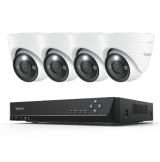
A 4 camera security system consists of four security cameras that can be placed at different locations and angles. They have a control unit, which is an NVR or Home Hub, to control all security cameras and save their recorded videos in local storage. Usually, an HDD is mounted in the control unit. An optional component is a large monitor/display to see the live feed of all security cameras at the same time.
4 Camera Wireless Security System: A 4 camera wireless security system does not require a wired connection for power, connectivity, or both. It can transmit data through a Wi-Fi network or 4G cellular connectivity. It gets power through a built-in battery or an adapter, which is connected to a nearby AC outlet. All four cameras are connected to the NVR/Home Hub via Wi-Fi, and that's how they store the recordings.
4 Camera Wired Security System: A wired security camera requires proper wiring from the cameras to the central/control unit. Digital cameras are connected to the NVR via an Ethernet cable, while analog cameras require a coaxial cable for connection to the DVR. It gets power and network connectivity through the cables. It is an extremely reliable option for fast and robust performance.
1. Plan Coverage for Four Key Areas
For a typical Australian detached home, four cameras can cover the front entrance, driveway, backyard, and side gate. Prioritise entry points and areas where people or vehicles regularly pass.
Check each camera's field of view before installation. A wide-angle camera may cover an entire front yard, while a narrower view can provide more detail at a gate or doorway. Avoid positioning cameras where walls, fences, or trees block important areas.
2. Match Resolution and Zoom to Monitoring Distance
For entrances and smaller outdoor spaces, 4K resolution can provide detailed footage when cameras are positioned appropriately. However, resolution alone does not determine how clearly you can see distant objects.
If you need to monitor a long driveway or a gate far from the house, consider cameras with optical zoom. For larger backyards or open commercial areas, pan-tilt cameras with automatic tracking can follow moving subjects across different parts of the scene.
3. Choose a Connection Type That Suits Your Property
PoE systems are suitable for permanent installations where Ethernet cables can run from the NVR to each camera. They transmit power and data through a single cable, avoiding the need for separate power outlets at camera locations.
For Australian homes where running Ethernet cables through walls or roof spaces is difficult, Wi-Fi systems may be easier to install. However, most Wi-Fi CCTV cameras still require a nearby power supply, and stable Wi-Fi coverage is essential for reliable recording.
4. Check Recording Duration and Storage Capacity
For a 4-camera CCTV system with 24/7 recording, check how many days of footage the NVR can retain. According to Reolink's NVR recording duration guide, a 2TB HDD can store approximately 6–12 days of continuous footage from four cameras at main-stream bitrates of 4096–8192 Kbps per camera.
Actual recording duration depends on the camera's bitrate, recording streams, and storage settings. If you need longer retention for a home or business, choose an NVR with expandable HDD storage or consider motion-triggered recording to reduce storage usage.
5. Consider Outdoor Conditions and Future Expansion
For outdoor installations in Australia, check the camera's IP weather-resistance rating and operating temperature range. Cameras installed under direct sunlight, exposed to heavy rain, or mounted near coastal areas may require additional consideration.
Also check the NVR's channel capacity. An 8-channel NVR can accommodate up to eight compatible cameras, allowing you to start with four and add coverage for a shed, garage, workshop, or additional entrance later.
- Place the security cameras strategically to cover key entry points and locations. Ensure that none of the cameras have an overlapping field of view for maximum coverage.
- Turn on the camera to ensure power connectivity. Connect it to the Wi-Fi and check the signal strength. If it is a PoE camera, check its connectivity with the router.
- Place cameras at least 8-10ft high and adjust them at suitable angles to avoid direct light and obstruction and wider coverage.
- During the initialization, set up a strong password to prevent hacking attempts. Also, set up two-factor authentication for added security.
- Test the security camera system and the live feed of all camera. Ensure everything is working fine, along with real-time alerts.
In Australia, a professionally supplied and installed 4-camera CCTV system typically costs around AUD $1,400–$2,500, including cameras, an NVR, cabling, and installation. If you already own the system, professional installation generally starts from AUD $150–$250 per camera. DIY installation can save on labour costs, but you still need to purchase the equipment and any additional cables or mounting accessories.
It depends on the location, area, entry points, layout, and other factors. For a small home or store, it is enough. But if the property is large with a complex layout, you need more security cameras. Select an expandable system so that you can add more cameras easily.


Be Prepared, Be Ahead
Never miss Reolink hot deals, news, and updates tailored for you.
Be Prepared, Be Ahead
Never miss Reolink hot deals, news, and updates tailored for you.

Google, Google Play, Google Assistant and related marks and logos are trademarks of Google LLC. Amazon, Alexa and all related logos are trademarks of Amazon.com, Inc. or its affiliates. Mac and Safari are trademarks of Apple Inc. App Store is a service mark of Apple Inc., registered in the U.S. and other countries. Firefox and the Firefox logo are trademarks of the Mozilla Foundation in the U.S. and other countries. Other product and company names mentioned herein may be trademarks of their respective companies.